 All Samples
 US Diplomas
 CAD Diplomas
 UK Diplomas
 AUS Diplomas
 MAY Diplomas
 GER Diplomas
 Other Diplomas
Introduction
The Cambridge English FCE, now officially known as B2 First, is one of the most widely recognized upper-intermediate English qualifications in the world. Developed by Cambridge English, part of Cambridge University Press & Assessment, this qualification demonstrates that a candidate can use everyday written and spoken English confidently in both academic and professional settings.
Because of its international reputation and structured assessment model, the FCE certificate is often regarded as a significant milestone in a learner’s language journey. However, beyond the exam itself, many candidates and institutions are interested in understanding how the certificate is structured, how scores are calculated, and why it carries such strong global recognition.
In this guide, we will explore these aspects in detail.
What Is Cambridge English FCE?
The Cambridge English FCE corresponds to Level B2 on the Common European Framework of Reference (CEFR), which was developed by the Council of Europe. At this level, candidates are expected to:
-
Understand the main ideas of complex texts
-
Interact with a degree of fluency and spontaneity
-
Produce clear, detailed written communication
-
Express opinions and explain advantages or disadvantages
In other words, B2 level indicates that a learner is capable of functioning effectively in English-speaking academic or workplace environments.
As a result, the FCE qualification is frequently accepted by universities, employers, and professional organizations worldwide.
1️⃣ What is Cambridge English FCE
Cambridge English FCE, now officially known as B2 First, is an upper-intermediate English language qualification designed for learners who can use English confidently in everyday academic and professional environments. It corresponds to Level B2 on the Common European Framework of Reference (CEFR), which means candidates are expected to communicate clearly, understand detailed texts, and participate in discussions with relative fluency.
The qualification is widely recognized by universities, employers, and institutions around the world. Because it focuses on practical language skills rather than memorization, the exam assesses real-life communication ability. In other words, candidates must demonstrate that they can read complex texts, write structured responses, follow spoken conversations, and express opinions effectively.
For many learners, FCE represents a major milestone. It bridges the gap between intermediate and advanced proficiency and often serves as preparation for higher-level exams such as C1 Advanced. Therefore, achieving this certification signals readiness for more demanding academic or workplace contexts.
2️⃣ How to Understand FCE Score
Understanding the FCE score requires familiarity with the Cambridge English Scale. Instead of simply giving a pass or fail result, the exam provides a detailed numerical score that reflects overall performance as well as individual skill levels.
Typically, scores range from 140 to 190. A score between 160 and 179 confirms performance at CEFR Level B2, while a score of 180 or above indicates performance approaching C1 level. Conversely, scores slightly below 160 may still demonstrate strong B1 ability.
Importantly, the Statement of Results breaks down performance in Reading and Use of English, Writing, Listening, and Speaking. This allows candidates to see not only their overall level but also their strengths and weaknesses. Consequently, learners can plan further study more strategically.
In essence, the scoring system provides transparency. Rather than a single grade, it offers a detailed picture of language competence aligned with international standards.
3️⃣ Cambridge FCE Certificate Sample Structure
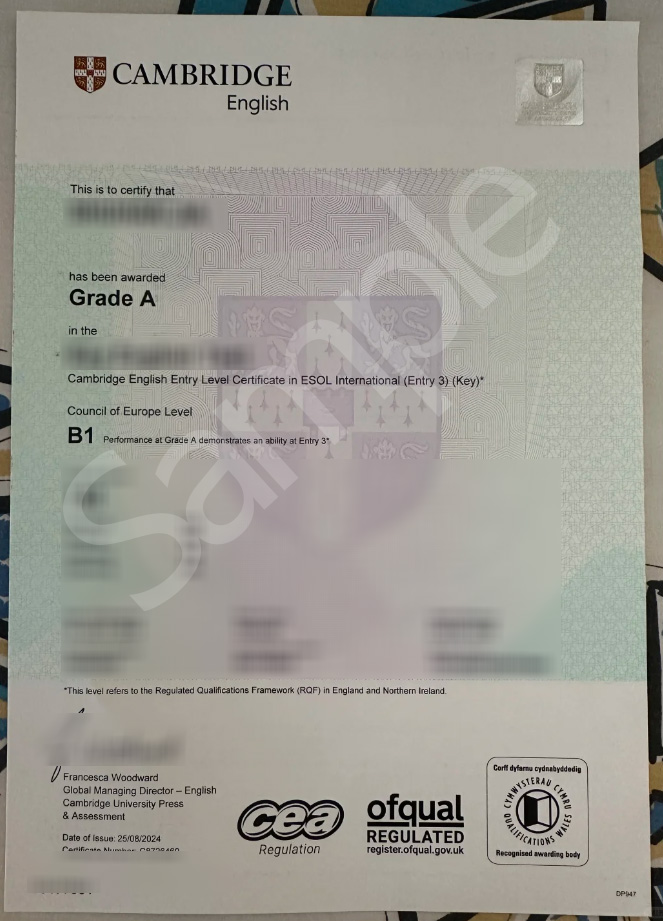
A typical Cambridge FCE certificate follows a standardized layout used across Cambridge English qualifications. While visual design elements may vary slightly over time, the structure remains consistent to ensure clarity and authenticity.
The certificate usually includes the candidate’s full name, the qualification title (B2 First), the CEFR level achieved, and the overall score. In addition, it displays the date of examination and official signatures from the awarding body. Unique reference numbers are also printed to facilitate record verification.
Furthermore, the document incorporates formal formatting elements such as official logos, typographic hierarchy, and regulated statements. These components contribute to a clear and professional presentation.
Understanding the structure of the certificate can be helpful for academic administrators, employers, and candidates alike. It ensures that the document is interpreted correctly and that the qualification level is immediately recognizable within international contexts.
4️⃣ B2 First Exam Scoring System
The B2 First exam scoring system is designed to measure language ability in a balanced and structured way. Each of the four core skills—Reading and Use of English, Writing, Listening, and Speaking—contributes equally to the final score.
Performance in each section is converted into a scaled score using the Cambridge English Scale. These scores are then averaged to produce an overall result. Because of this method, consistency across skills is important; strong performance in one area cannot fully compensate for very weak performance in another.
Moreover, grades are typically classified as Grade A, B, or C within the B2 band, depending on the score range achieved. A Grade A often reflects performance at a level higher than standard B2.
Overall, the scoring framework emphasizes fairness and clarity. By aligning results with CEFR levels, it ensures that outcomes are internationally comparable and easily understood by institutions worldwide.
5️⃣ Cambridge English B2 Certificate Meaning
A Cambridge English B2 certificate signifies that the holder has reached upper-intermediate proficiency in English. At this level, individuals can engage in extended conversations, understand detailed written texts, and produce clear, well-structured writing.
More specifically, B2 indicates that a learner can function independently in English-speaking environments. For example, they can participate in meetings, follow academic lectures, and express opinions with reasonable fluency. Therefore, the certificate often serves as proof of readiness for university study or professional work in English.
In addition, B2 proficiency suggests the ability to adapt language to different contexts. This includes formal writing, semi-formal communication, and collaborative discussions.
Consequently, the certificate is not merely an exam outcome; rather, it represents a validated standard of communicative competence recognized internationally.
6️⃣ Difference Between FCE and CAE
The primary difference between FCE (B2 First) and CAE (C1 Advanced) lies in the level of language complexity required. While FCE corresponds to CEFR Level B2, CAE represents Level C1, which is a more advanced stage of proficiency.
At B2 level, candidates are expected to handle everyday and moderately complex communication. However, at C1 level, learners must demonstrate greater precision, flexibility, and depth of expression. Texts become more abstract, and spoken tasks require higher fluency and sophistication.
In addition, vocabulary range and grammatical accuracy are assessed more rigorously in the C1 Advanced exam. Consequently, CAE is often required for postgraduate study or professional licensing in English-speaking environments.
In summary, FCE confirms strong independent use of English, whereas CAE signals advanced mastery and greater linguistic control.
7️⃣ Cambridge English Qualification Levels
Cambridge English qualifications are structured according to CEFR levels, creating a clear progression pathway for learners. The framework begins with entry-level exams for young learners and gradually advances to high-level academic proficiency assessments.
For general English learners, the pathway typically follows this order: A2 Key, B1 Preliminary, B2 First, C1 Advanced, and C2 Proficiency. Each stage builds upon the previous one, increasing in complexity and communicative demands.
Because the qualifications are aligned with CEFR standards, they provide internationally recognized benchmarks. This alignment ensures that learners, educators, and employers can interpret results consistently across countries.
Ultimately, the structured progression helps students set realistic goals. By understanding the qualification levels, candidates can plan long-term language development with clarity and confidence.
Exam Structure and Assessment Components
The FCE exam is divided into several components, each designed to assess a different language skill. These include:
-
Reading and Use of English
-
Writing
-
Listening
-
Speaking
Each component contributes to the overall score. Importantly, performance in each skill area is clearly reported, allowing candidates to understand their strengths and areas for improvement.
Moreover, the scoring system is based on the Cambridge English Scale, which provides a standardized score range aligned with CEFR levels. Typically, FCE scores fall between 140 and 190, with 160–179 representing solid B2 performance.
Because the reporting system is transparent and detailed, institutions can easily interpret a candidate’s proficiency level.
-
Cambridge English PET Guide
-
Cambridge C1 Advanced Overview
-
Understanding CEFR Levels
-
English Certificate Scoring System
Certificate Format and Key Information
A Cambridge English FCE certificate generally includes:
-
Candidate’s full name
-
Qualification title (B2 First)
-
CEFR level
-
Overall score
-
Date of examination
-
Unique reference numbers
-
Official signatures and regulatory marks
In addition, the certificate layout incorporates various security and print elements to ensure document integrity. These design elements are part of the standardized structure used across Cambridge English qualifications.
Understanding this structure is useful not only for candidates but also for academic administrators and HR departments who review such credentials.
Global Recognition and Academic Value
One of the primary reasons candidates pursue the FCE qualification is its international recognition. Because it is regulated in the UK and aligned with global language standards, the certificate is widely trusted.
Furthermore, many educational institutions accept B2 First as proof of upper-intermediate English proficiency for admissions purposes. Likewise, employers often view it as a reliable indicator of communication competence.
Therefore, the FCE certificate is not simply an exam result; rather, it represents a validated level of English proficiency that can support academic and professional advancement.
Why Understanding Certificate Details Matters
While most candidates focus on passing the exam, it is equally important to understand how the certification system works. For example:
-
How are scores interpreted?
-
What does Grade A, B, or C indicate?
-
How does B2 compare to other CEFR levels?
By gaining clarity on these aspects, learners can better plan their progression toward higher qualifications such as C1 Advanced or C2 Proficiency.
Additionally, institutions that handle academic documentation benefit from understanding the format and structure of English proficiency certificates, especially when organizing internal records or preparing official presentations.
Presentation and Documentation Considerations
In educational and professional settings, clear documentation plays a crucial role. Whether for portfolio presentation, training records, or archival purposes, well-designed credential documentation supports credibility and organization.
For individuals and institutions seeking structured layout design or professional presentation formatting for training achievements, having a clear understanding of official qualification structures is particularly helpful.
Therefore, attention to layout consistency, typographic hierarchy, and standardized formatting contributes to a more polished and professional presentation.
Conclusion
The Cambridge English FCE (B2 First) remains one of the most respected English language qualifications worldwide. Not only does it confirm upper-intermediate proficiency, but it also provides a clear, standardized reporting framework aligned with international benchmarks.
Because of its structured scoring system, globally recognized CEFR alignment, and formal certificate format, the FCE qualification continues to serve students, educators, and professionals across diverse sectors.
Ultimately, understanding the exam structure, scoring interpretation, and documentation format enables candidates and institutions alike to make informed decisions regarding academic progression and professional development.