 All Samples
 US Diplomas
 CAD Diplomas
 UK Diplomas
 AUS Diplomas
 MAY Diplomas
 GER Diplomas
 Other Diplomas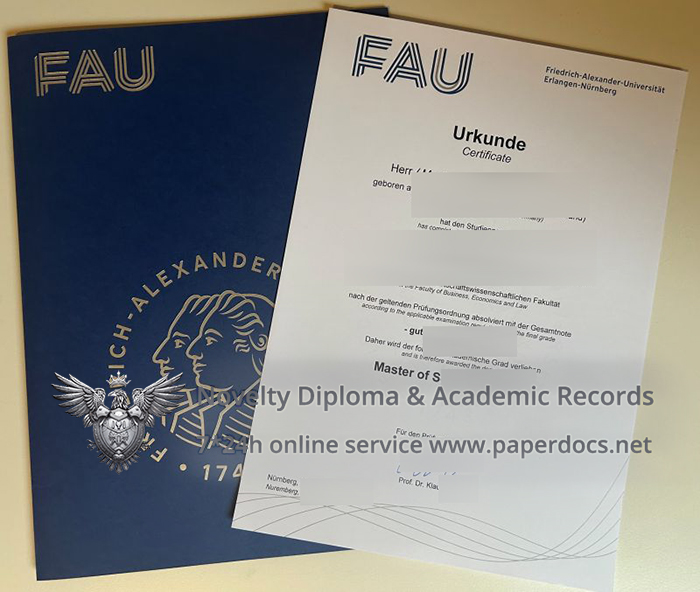
FAU Urkunde, Alexander-Universität Erlangen diploma sample. The University of Erlangen-Nuremberg (Friedrich-Alexander-Universität Erlangen-Nürnberg, abbreviated FAU), located in Franconia, Bavaria, Germany, is a public research university with a glorious history spanning nearly three centuries. Founded in Bayreuth in 1742 and moved to Erlangen the following year, its name comes from two important patrons—Marquis Friedrich of Brandenburg-Bayreuth and Marquis Christian Friedrich Karl Alexander of Brandenburg-Ansbach. In 1972, the School of Economics and Education, located in Nuremberg, merged with FAU, making it the second largest state-owned comprehensive university in Bavaria and establishing its unique “two-city” structure.
FAU is distinguished in German higher education for its broad range of disciplines and interdisciplinary educational philosophy. The university comprises five faculties—Philosophy and Theology, Law and Economics, Medicine, Natural Sciences, and Engineering—offering over 250 majors and providing students with an extremely rich array of academic choices. This diversity allows students to easily pursue interdisciplinary studies; for example, computer science students can choose business administration, and biology students can explore the medical field, fully embodying the school motto of “Learning by Doing” (Wissen bewegt). Hochschule Schmalkalden urkunde.
In the field of research, FAU consistently ranks among Germany’s top research universities. In 2006, its Advanced Materials Engineering (EAM) cluster was successfully selected as one of Germany’s elite clusters, receiving €6.5 million in funding annually, signifying its international leadership in materials science. According to the QS World University Rankings, FAU’s materials science program consistently ranks among the top 50 globally, and its communications engineering program has repeatedly ranked first in Germany. These achievements are inseparable from the close ties between the university and industry—FAU is a member of the TIME (Times of America) alliance of leading European universities for industrial management and maintains deep collaborations with institutions such as Siemens’ R&D headquarters, the Fraunhofer Society (the birthplace of the MP3 format), and the Max Planck Institute.
The medical school is undoubtedly one of FAU’s most dazzling jewels. Located in Erlangen, the “Federal Medical Capital,” the University Hospital has repeatedly made history in German and world medicine: the first successful kidney transplant in 1966, the birth of Germany’s first test-tube baby in 1982, and the world’s first MEG (magnetic-encephalogram) surgery for epilepsy in 2004. In 2008, Harald zur Hausen, a professor of virology at the university, was awarded the Nobel Prize in Physiology or Medicine for his discovery of the mechanism by which human papillomavirus (HPV) causes cervical cancer, adding the highest honor to the university’s medical research. Today, Erlangen University Hospital remains among the top hospitals in Germany in areas such as cancer treatment and organ transplantation.
The alumni list of FAU is stellar, bringing together many thinkers and practitioners who have changed the world. The physics giant Ohm discovered the law named after him here; the father of organic chemistry, Liebig, laid the foundation for modern chemistry; the mathematician Felix Klein proposed the epoch-making “Erlangen Program”; and philosophers Fichte, Schelling, and Feuerbach drew inspiration from here. In the political and economic spheres, Ludwig Erhard, the Chancellor of West Germany, hailed as the “father of the social market economy,” also graduated from this university. It’s worth noting that FAU has also produced several Nobel laureates, including Emil Fischer (1902 Chemistry Prize laureate), Eduard Büchner (1907 Chemistry Prize laureate), and the aforementioned Professor Hausen.
As a classical university that deeply integrates modern technology with its humanistic traditions, the University of Erlangen-Nuremberg has always maintained its unique charm. From Ohm’s Law to the MP3 format, from the first test-tube baby to Nobel Prize-winning medical discoveries, FAU has continuously pushed the boundaries of human knowledge for nearly three centuries. For today’s students, it is not only a place to receive first-class academic training, but also a thought-provoking home connecting a glorious history with an infinite future.